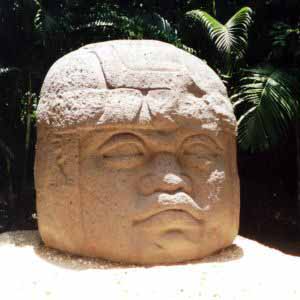
Until the early 1900’s, the Maya civilization was considered to be the parent culture in Mesoamerica from which all other societies sprouted. There have been many Mayan sculptures and carvings found in the region, so all other carvings were also considered to be that of the Maya. One difference in the carving is that some carvings of large heads had faces with more African looking features than many of the other Mayan works.
There was also evidence of a half-jaguar half-man beast, which also did not fit in with other Mayan finds. It wasn’t until 1929, when Marshall H Saville, the Director of the Museum of American Indian in New York, classified these new works as an entirely new culture not of Mayan heritage. He named this culture Olmec, which means the “rubber people” in Nahuatl, the language of the Mexica (“Aztec”) people. It was the Aztec name for the people who lived in this area at the much later time of Aztec dominance. Ancient Mesoamericans, spanning from ancient Olmecs to Aztecs, extracted latex from Castilla elastica, a type of rubber tree in the area. The juice of a local vine, Ipomoea alba, was then mixed with this latex to create rubber as early as 1600 BC.
It is not known what name the ancient Olmec used for themselves. Later Mesoamerican accounts seem to refer to the ancient Olmec as “Tamoanchan”.
The oldest Olmec site originated at its base in San Lorenzo, Tenochtitlan, where distinctively Olmec features begin to emerge around 1150 BC. The rise of civilization here was probably assisted by the local ecology of well watered rich alluvial soil, encouraging high maize production. This ecology may be compared to that of other ancient civilizations: Mesopotamia and the Nile River Valley.
At its height, this village had a population of less than 1,000 people. The inhabitants were farmers and fishermen who also did a small amount of hunting. The major crops were maize, beans, and squash. The fishing season coincided with the flooding of the river. The men would catch fish in landlocked ponds after the flooding of the river subsided. Along with fish, the Olmec would catch turtles for their main source of protein. If the fishing was slow and the turtle hunting was not going well, the Olmec would substitute domesticated dog and turkey meat in their diet.
It is speculated that the dense population concentration at San Lorenzo encouraged the rise of an elite class that eventually ensured Olmec dominance and provided the social basis for the production of the symbolic and sophisticated luxury artifacts that define Olmec culture.
Evidence of materials in San Lorenzo that must have come from distant locations suggests that early Olmec elites had access to an extensive trading network in Central America. This was most likely be protected by some sort of military system.
It is not known with any clarity what happened to this culture. Their main center at San Lorenzo, was all but abandoned around 900 BC, and La Venta became the main city. Environmental changes may have been responsible for this move, with certain important rivers changing course. However, there is also some evidence suggestive of an invasion and destruction of Olmec artifacts around this time.
Around 400 BC, La Venta also came to an end, although the importance of the ceremonial complexes apparently outlasted the Olmec state or culture. Within a few hundred years of the abandonment of their last cities, successor cultures had become firmly established in their former lands, most notably the Maya to the east, the Zapotec to the southwest, and the Teotihuacan culture to the west.
http://www.crystalinks.com/olmec.html